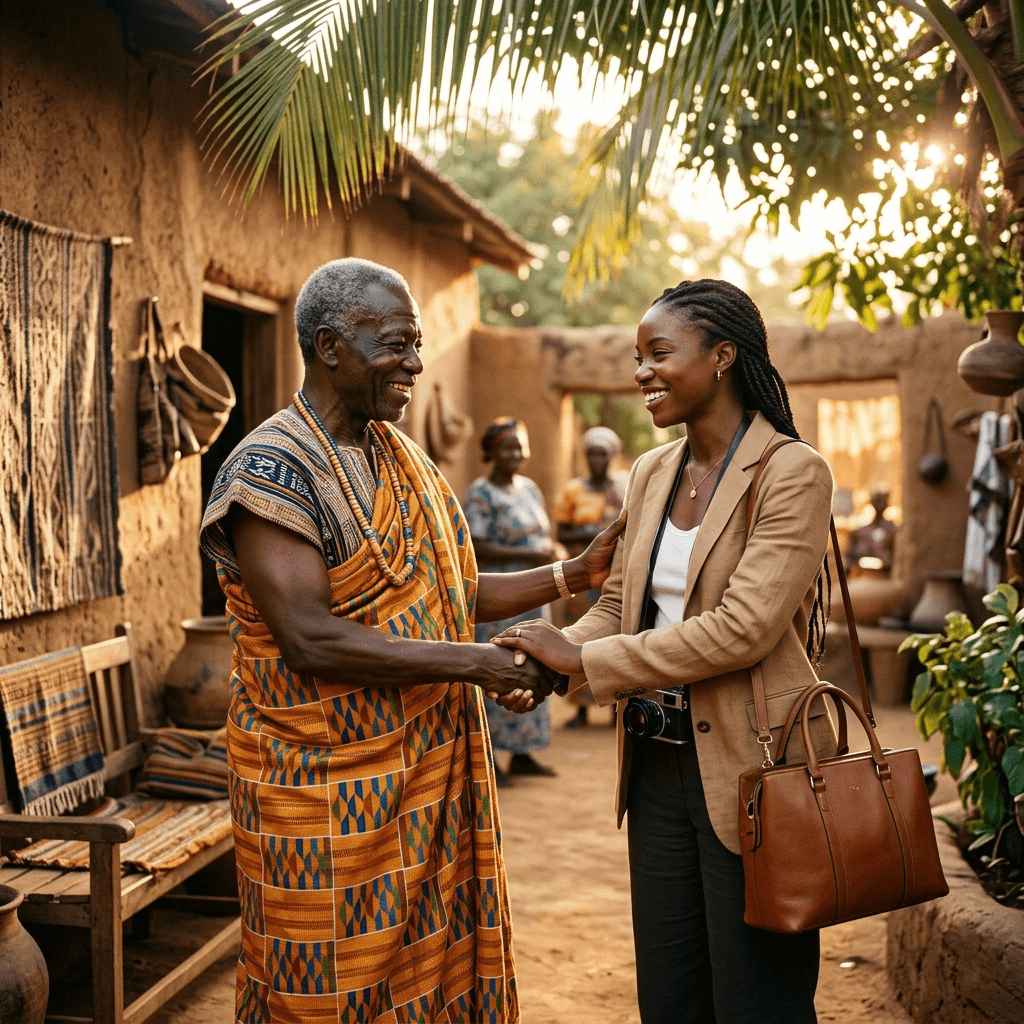
Africa is not a monolith—it is 54 distinct nations, each with its own rich tapestry of customs and social norms. However, certain universal threads of respect, eldership, and community weave throughout the continent.
1. The Art of the Greeting
In much of the Western world, a greeting is a quick "hello" in passing. In Africa, greetings are the foundation of all social interaction and commerce. Rushing past an elder, a shopkeeper, or your guide without exchanging proper pleasantries is considered extremely rude.
- Take Your Time: Ask "How are you? How is your family? How is your morning?" before launching into a transaction.
- The Right Hand Rule: In almost all African societies, particularly in Muslim nations (like Senegal, Morocco, and Egypt) and West Africa (like Ghana and Nigeria), you must ONLY give, receive, or eat with your right hand. The left hand is traditionally reserved for personal hygiene.
- Respect for Elders: Always acknowledge and greet the oldest person in the room first. In some cultures, avoiding direct eye contact with an elder or a chief is a sign of deep respect, not shiftiness.
2. Photography & Consent
One of the most offensive things a traveler can do is thrust a heavy camera lens into a local person's face without permission. You are visiting their home, not a human zoo.
Never Photograph Government Buildings
Across the continent, it is strictly illegal and dangerous to photograph military personnel, border crossings, airports, presidential palaces, or police outposts. Doing so can result in the immediate confiscation of your camera, or worse.
If you wish to take a portrait of a market vendor or a local child, ask first. A smile and a polite gesture pointing to your camera ("May I?") goes a long way. If they say no, accept it gracefully. In some communities (such as the Maasai in East Africa), photography may require a small fee or tip—this is a valid economic exchange, not a scam.
3. The Dance of Bargaining
In markets stretching from the grand souks of Marrakech to the craft stalls of Cape Town, haggling is not an argument—it is a social interaction.
Haggling Do's
- Start with a smile and a greeting.
- Counter the first offer with roughly 40-50% of the asking price, expecting to meet in the middle.
- Treat it as a game of mutual respect. Drink the mint tea if offered.
Haggling Don'ts
- Do not get angry or raise your voice.
- Do not start haggling if you have zero intention of buying.
- Do not argue intensely over 50 cents. What is a trivial amount to you may be significant to a local artisan.
4. Modesty in Dress
While safaris often call for shorts and t-shirts, cities, rural villages, and religious sites demand far more conservative attire. In North Africa (Morocco, Egypt) and deeply religious communities globally, shoulders and knees should be covered. Even in more modernized cities like Accra or Nairobi, dressing neatly and elegantly is a sign of self-respect and respect for others in the community.
5. "African Time"
In many Western cultures, "time is money." In many African cultures, relationships and circumstances hold more value than the clock. If a meeting or a transport departure is delayed, visible frustration will accomplish nothing. Embrace the slower pace. As the famous Swahili proverb goes: "Haraka haraka haina baraka" (Hurry, hurry has no blessing).